
-
Mole Control
Pest Controllers – Mole Removal
To get your free mole control quote click here.-
Moles are present throughout Europe, Asia, Southern Africa and North America. There are approximately 30 species of moles around the whole world but the only mole in the UK is “Talpa Europea” otherwise known as the European Mole. There are supposedly no moles whatsoever in Ireland.
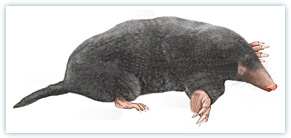
The Mole is a small animal which grows to about 80g in weight as an adult, who then consumes an average of 50g of worms a day, that’s the equivalent of 200 worms a day to survive! Moles work all year round, tunnelling underground, building great, elaborate fortresses for themselves. They live off insects but their favourite is worms, they bite off the heads and store the bodies in a chamber in their fortress to be consumed at a later date.
Moles are dark skinned animals, varying in shade from silvery grey to extreme black. Their eyes are small and set fully hidden in their fur so they would appear to be completely blind but can in fact differentiate between light and dark.
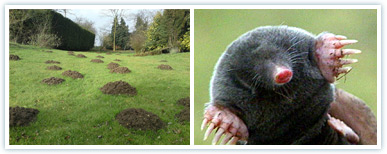
Moles have sensory hairs around their face, chin, ears and tail which allow them to detect worms and insects. They hold their short tails semi-upright whilst tunnelling, which makes it easier to brush the tunnel walls and sense the vibrations passing through the ground, to warn them of any predators. The hair on their bodies is very soft, almost like velvet and thicker around the centre than at the ends, which helps protect them from dirt and water and allows a much easier freedom of movement through the tunnels under the ground. Moles also have a pair of scent glands under their skin which are connected to the urinary tract and the moles use this to mark their territory. In the breeding season the male moles are able to use this to identify the female moles occupying the territory.
They don’t actually have ears as such, but holes in their head and to make up for the fact they can’t see very well, their hearing is intensely acute and they can pick up the sounds of other moles and predators from far around.
The mole’s front legs are strong and shaped like a pair of paddles facing outwards, its hands are quite large in proportion to its body, with strong fingers and nails ready and willing to vigorously dig their way through anything. Its hind legs are longer and are mainly used to push the mole forward while the front legs are digging.
Moles work on a rotational sleeping/working pattern of 4 hours. They create over 20 metres of fresh tunnels every day, but focus on a patrolled run system at regular intervals until all the food has been scavenged and then they move to a new area to begin a new run. Mole hills are created in this process whilst the soil is loosely dug up and left behind.
The mole fortress contains several layers of tunnels, shallow surface tunnels, and deeper tunnels for breeding and feeding. Mole hills are often found in areas of high water tables or on land which can become flooded. They are more obvious because the mole builds its nest above the water level to ensure it is kept dry. Moles are actually great at swimming and don’t have a problem escaping to higher ground when they are faced with floods.
Soil aeration and the removal of garden pests, such as cockchafer grubs are really the only two advantages to having moles in your garden. Other than that they are considered a pest, which need to be controlled. Their busy tunnelling leaves dirty great mole hills all across lawns, golf courses, cricket pitches and crops, causing much anguish and dismay amongst farmers and others affected.
During the last outbreak of Foot and Mouth disease, rural pest controllers were banned from accessing most areas of countryside, which in turn allowed the Moles to breed in peace and has resulted in record numbers of mole complaints in recent years.
Moles are quite solitary creatures and they tend to busy away their time tunnelling and eating. The males and females live completely apart except in breeding season, when the males will dig with increased speed and vigour in an attempt to source a mate. Between February and June they usually give birth to a litter of 3 to 4 moles but sometimes as many as seven. Newborn moles are born bald and blind and weigh about 3.5 grams. Their hair begins to grow after 14 days and when they are 22 days old they start seeing and moving. Both mother and father mole look after and feed their offspring and after 5 or 6 weeks the baby moles are ready to find a territory of their own and this is when they travel above ground in order to find it. They are at most risk from predators at this time and must take great care. Moles can live up to six years, but usually only about 3. Territories tend to overlap, which means as soon as a mole has vacated its territory it is very quickly taken over by another mole that will sense that it has been vacated and will quickly move in. The truth about moles is still relatively unknown, even by scientists because they spend so much of their time underground they are not easily observed and it costs too much to take them into captivity because of the enormous quantities of food they need to consume.
Moles were hailed as heroes by the Jacobites in 1702 after they were believed to have caused the death of King William III when his horse stumbled on a molehill, knocking him off and breaking his collar bone. After that the Jacobites would regularly make a toast to “THE LITTLE GENTLEMAN IN BLACK VELVET".
There are various methods of Mole control including a sonic device that you stick in the ground, it is reported to emit a vibrating sound that disturbs the moles, but successful reports of this working are dubious. Aluminium Phosphide gassing is another method but specialist training is required before use and finally there are many forms of trapping available. Because Moles are impossible to capture and there are so many of them, it really is better that you contact professional pest controllers to deal with your problem. They are specially trained and have the latest equipment and techniques required for eradicating them from your garden or field.
The use of traps can be quite successful if they are set correctly in the first place, however, there are so many moles out there you would never be likely to catch them all and if you do catch one it must be dispatched of humanely, which is again best left up to the professionals.
-
Call Me Back Now

- Area Covered

 See All Locations
